Easy Installation Of Your Custom Printed Wallpaper Mural
Everything you need to hang your Redcliffe custom printed wallpaper. Your B measurement and number of drops are on the order header sheet that comes with your wallpaper, and the header sheet and instructions are colour coded to your wallpaper type.
Which wallpaper do you have?
Your printed instructions are colour coded — follow the section in the same colour: Purple Smooth 2.1 Green RP Classic Orange Peel & Stick
Never use vinyl adhesive, ready-mixed tub paste or any heavy-duty adhesive — under any circumstances. These set too quickly, stop you repositioning the paper and can cause bubbling, patching and adhesion failure. Mix the paste fresh to the manufacturer's instructions. If you're unsure which paste to buy, please contact us before you start.
Check every drop first
Unroll and inspect all your drops before you begin. If anything looks wrong, contact us before cutting or hanging anything.
Two pairs of hands
A helper makes it much easier — one person holds and positions each drop, the other smooths it into place.
1. What you'll need
- Medium-duty cellulose wallpaper paste (Smooth 2.1)
- Medium-pile roller and a cutting-in brush
- Soft spatula or wallpaper smoother
- Spirit level or plumb line, and a pencil
- Wallpaper trimming knife with plenty of spare blades
- Long metal straight edge
- Clean damp sponge and a bucket of water
- Masking tape and a felt-sided squeegee (Peel & Stick)
2. Prepare your wall
- Inspect and repair. The wall must be sound, clean and completely dry. Remove all loose paint, plaster or old paper, fill holes and cracks, then sand smooth once the filler has set.
- Paint with at least two coats of emulsion, letting each coat dry fully. This gives a stable, even surface to stick to.
- "Size" the wall. Sizing seals porous surfaces so the paste doesn't dry too fast, and gives you time to slide and reposition each drop. Beeline Primer Sealer is highly recommended — it also helps reduce seam splits, raised edges and bubbling.
Never hang on a damp wall — it's the most common cause of wallpaper failure. If in doubt, wait another 24 hours.
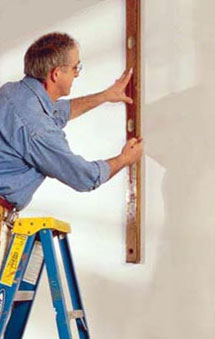
3. Mark your start line & hanging order
- Measure your B measurement (on your order header sheet) in from the left-hand edge of the wall. Mark it at the top, middle and bottom.
- Draw a vertical pencil line through the marks from ceiling to floor using a plumb line or spirit level. Few walls are truly square, so never use a corner or door frame as your guide.
- Hang drop 2 first, with its left-hand edge on your line. Carry on to the right with drops 3, 4 and so on, and hang drop 1 last on the far left. Any slight mismatch then ends up in the corners, where it's least visible.
About your drops: your mural is split into the fewest drops possible to keep joins to a minimum, so drops can be 800mm to 1200mm wide. Each drop is numbered at the top, with drop 1 on the far left. Pasted wallpapers (Smooth 2.1 and RP Classic) overlap by 30mm at each seam, while Peel & Stick drops are butt-joined with no overlap. An extra 100mm bleed is added to the far left and far right drops and to the top and bottom of every drop for trimming.
Drop 2 goes up first on your plumb line. Your wall may have more or fewer drops than shown.
4. Digimura Smooth 2.1 Purple guide
Paste the wall Premium durable wallpaperPaste the wall — not the wallpaper. Use medium-duty cellulose wallpaper paste only. Never use vinyl adhesive or ready-mixed tub paste.
- Paste the wall for one drop only. Roll on a generous, even coat of paste with a medium-pile roller, slightly wider than the drop. Use a cutting-in brush along the ceiling, skirting and corners.
- Hang drop 2. Line its left-hand edge up exactly with your pencil line, working from the top down. Leave the excess at the ceiling and floor for trimming.
- Smooth it on. Use a soft spatula from the centre outwards in a smooth up-and-down motion, pushing air towards the edges. Take care not to squeeze paste out at the edges. If a large bubble won't move, gently peel back and re-lay.
- Hang the next drop with a 30mm overlap. Paste the next section of wall, then hang the drop so it overlaps the previous one by 30mm. Match the image across the overlap before pressing down. Double cut the seam if you want a near-invisible join (see step 5).
- Trim top and bottom against a straight edge in one clean cut. Wipe any paste off the printed surface straight away with a damp sponge.
- Finish with drop 1 on the far left, then check every edge and seam is stuck down.
4. Digimura RP Classic Green guide
Ready pasted — just add water Standard wallpaperNo extra paste needed. Water activates the paste already on the back. Never use vinyl adhesive or ready-mixed tub paste.
- Soak the drop in water for 15 seconds.
- Fold and rest. Lay the drop on a clean table, paste side up. Fold one end towards the middle, then the other end into the middle, and leave it for 1 minute to activate the paste.
- Hang drop 2 on your pencil line, then smooth it out with a damp sponge, wiping off any paste or dripping water.
- Continue with a 30mm overlap on each drop, matching the image, trim top and bottom, and finish with drop 1 on the far left.
4. Peel & Stick Orange guide
Self adhesive — no pasteButt-joined seams Self adhesive wallpaper- Position with masking tape. Hold drop 2 in place on your pencil line with masking tape and check the alignment before peeling any backing.
- Peel and press in stages. Starting at the top, pull down 5cm to 8cm of the backing. Lightly press and smooth the exposed adhesive onto the wall, then keep pulling the backing down in 5cm to 8cm steps, smoothing as you go.
- Keep it straight. Once the drop is started, a helper can hold the bottom and pull down slightly, keeping it straight and under gentle tension.
- Butt-join the next drop — never overlap. Tape it in place so its edge meets the previous drop exactly, with no overlap and no gap. Match the image across the join, then peel and apply in the same way. Trim top and bottom and finish with drop 1 on the far left.
- Deal with bubbles gently. Peel the area back and re-apply with a soft, felt-sided squeegee at a 45 degree angle, using overlapping firm strokes. Don't press too hard, as this can damage the image. An air release tool can help with stubborn air pockets.
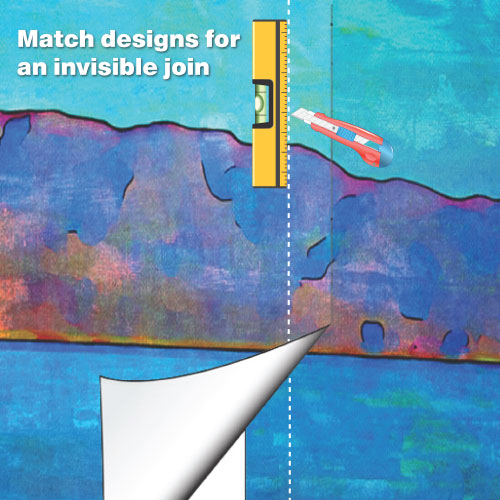
5. Double cut for near-invisible seams (optional)
Your mural looks great with the 30mm overlaps left as they are. For a close to seamless finish on pasted wallpapers, you can double cut each seam — the same technique professional decorators use.
- Match the image across the overlap.
- Hold a long metal straight edge firmly down the centre of the overlap.
- Cut through both layers in one steady stroke with a sharp trimming knife. Snap off the blade often — a blunt blade tears rather than cuts.
- Remove both waste strips. Peel off the top strip, lift the edge and pull out the strip underneath, then smooth both edges down and wipe away any paste.
The cut doesn't need to be perfect — just keep your eye on the middle of the overlap and go slowly. Continue across the wall, finishing with drop 1.
6. Tips, corners & aftercare
Small bubbles? Don't panic. Small bubbles and wrinkles usually disappear as the paste dries over 24–48 hours.
Internal corners. Don't fold one drop around the corner — take it about 10mm round, then treat the next wall face as a new start.
External corners. Wrap at least 25mm around the corner and secure the edge firmly.
Temperature. Hang at normal room temperature. Don't use direct heat to speed up drying — let the room ventilate naturally.
Cleaning. Once fully cured (allow 7 days), wipe marks gently with a slightly damp cloth. Avoid abrasive cleaners or solvents.
Something not right? If a drop looks faulty, stop and contact us before carrying on.
Would you rather a professional hung it?
If you're not familiar with hanging wallpaper, we recommend a professional decorator. The Painting and Decorating Association represents thousands of painters and decorators across the UK and can help you find a recommended member near you. Please pass this guide on to your decorator.